



Biography
A youth of Romanian avant-gardism
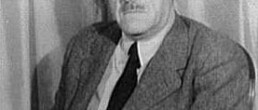
Victor Brauner was born in 1903 in Romania, in the Carpathian region. Attracted to art and new forms of expression from an early age, he studied at the Bucharest School of Fine Arts between 1918 and 1920, before being expelled in 1920. He quickly established himself as one of the major figures of the Romanian avant-garde and experimented with many artistic movements: expressionism, constructivism, Dadaism, before gradually turning to surrealism. From this period onwards, he developed an original way of thinking and invented the term ‘picto-poetry’, which sums up his desire to merge painting and poetic language.
Early days in Bucharest and Paris in artistic circles
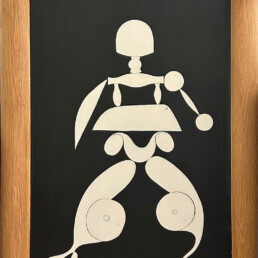
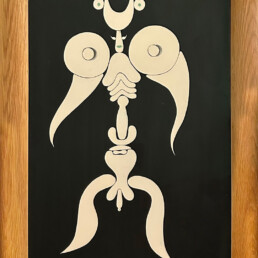
Between the 1920s and 1930s, Brauner travelled back and forth between Bucharest and Paris. His decisive meeting with André Breton in 1933 brought him fully into the surrealist circle. Settling in Paris in 1930, he befriended major artists such as Constantin Brancusi, Yves Tanguy and Alberto Giacometti, who, like him, lived on Rue du Moulin-Vert. Fascinated by the themes of death, dreams and somnambulism, particularly during his stays in Fălticeni, his work sometimes evokes that of Giorgio de Chirico, Salvador Dalí and Otto Dix, as in the character of Monsieur K. Between 1925 and 1938, he fully asserted his surrealist language. It was against this backdrop of the interwar period that he painted Un Homme et Une Femme (A Man and a Woman) in 1936, black and white works that convey universal forces beyond his control.
The painter magus
The year 1938 marked a major turning point in his life. Brauner joined the Communist Party and was the victim of a violent accident in Paris: he lost an eye as a result of a shard of glass during an altercation involving Oscar Domínguez and Esteban Francès. This event is considered premonitory, as he had painted Self-Portrait with Enucleated Eye seven years earlier. This episode reinforced his image as a visionary artist within the Surrealist movement, capable of revealing truths hidden by art.
The artist in retreat: refuge, magic and dreamlike imagery
During the Second World War, Victor Brauner took refuge in the south of France, hiding in the Hautes-Alpes to escape the German occupation. This period of isolation fuelled a deeply dreamlike and esoteric body of work. He turned to doctrines such as spiritualism, alchemy and tarot, which he saw as means of protection and knowledge. His universe became populated with witches, magicians, totemic figures and invisible worlds. It was in the context of the interwar period that he painted Un Homme et Une Femme (A Man and a Woman) in 1936, black and white works that convey universal forces beyond his control.
Consecration of a visionary painter
After the war, Brauner pursued a personal artistic quest, marked by the invention of figures such as Congloméros and the success of sculptures such as the plaster Wolf, exhibited at the Maeght Gallery in 1947. In 1945, he moved into the former studio of Le Douanier Rousseau, where he developed a mystical and archaic style of painting, inspired by Egyptian and pre-Columbian myths. Disagreeing with certain decisions made by the Surrealist group — notably the exclusion of Roberto Matta — he gradually distanced himself from them. His visionary and symbolic work sought out elementary and timeless forms. In 1966, the year of his death, Victor Brauner was chosen to represent France at the Venice Biennale, definitively confirming the importance of his artistic career.