



COMMUNE DE MAIXE, 1924A WINTER SCENE BY Maurice Utrillo
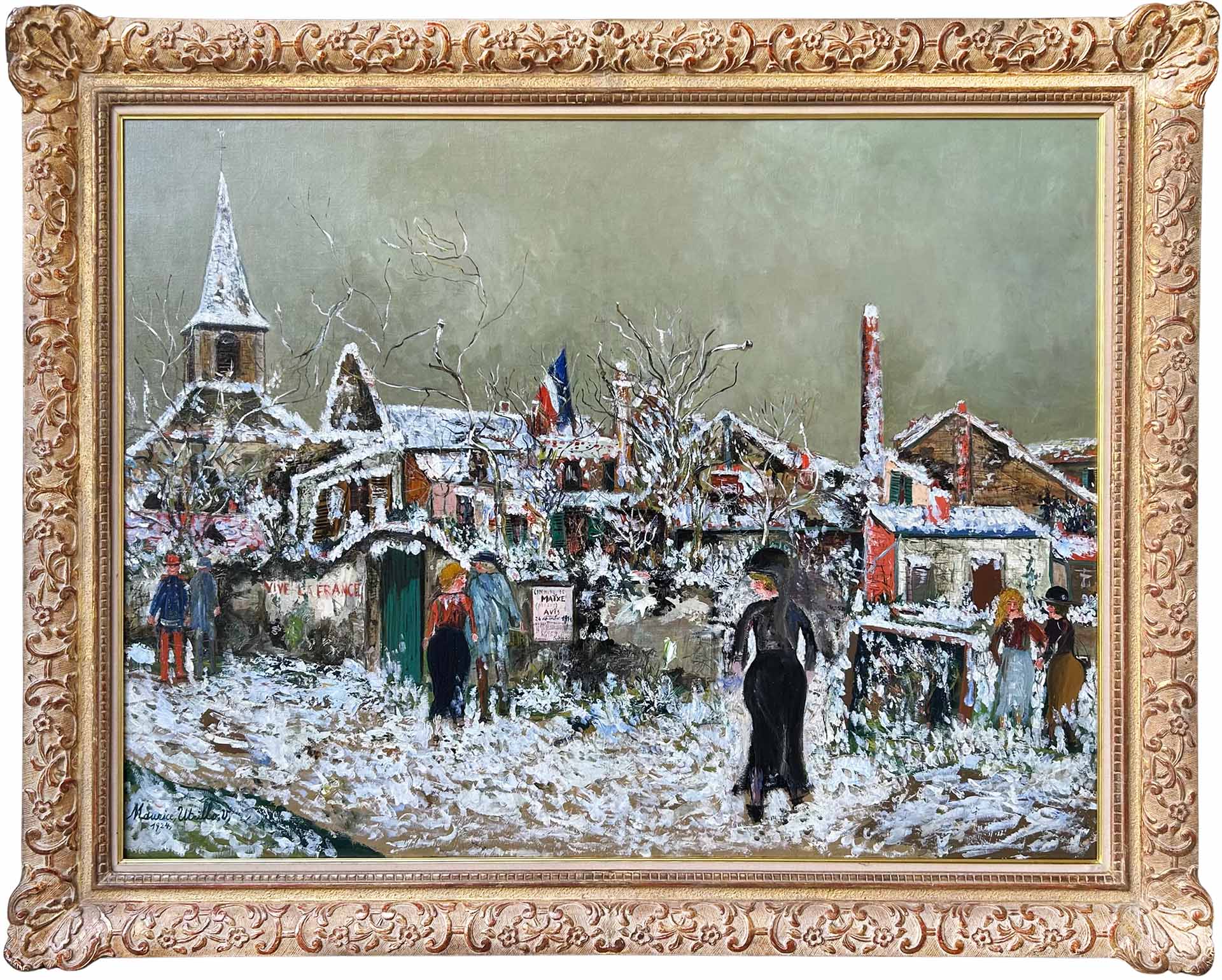
The Galerie Hurtebize is delighted to present Commune de Maixe (Meurthe-et-Moselle), a major oil on canvas painted by Maurice Utrillo in 1924. Listed in the artist’s catalogue raisonné and accompanied by a certificate from the Utrillo-Valadon Committee, this work aptly illustrates the painter’s ability to transform an everyday landscape into a deeply evocative scene.
Maurice Utrillo, painter of French towns and villages
A leading figure in 20th-century French painting, Maurice Utrillo (1883–1955) remains famous for his depictions of Montmartre and his urban landscapes, imbued with an instantly recognisable atmosphere. Through his streets, squares, churches and working-class houses, he captured the soul of French towns and villages with a unique sensitivity.
Whilst his name is often associated with views of Paris – Montmartre, the Place du Tertre, the Lapin Agile – his work also reveals a marked interest in provincial landscapes. Painted in 1924, Commune de Maixe is part of this quest for an authentic France, observed with care and rendered with great pictorial finesse.
A historic scene: between remembrance and renewal
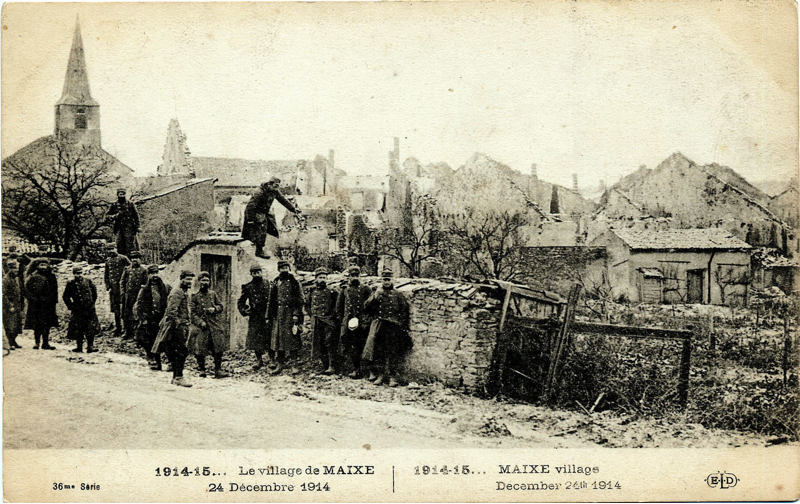
Maurice Utrillo created Commune de Maixe (Meurthe-et-Moselle) based on a postcard depicting the village in Lorraine. This approach was characteristic of his creative process at the time: the artist frequently worked from postcards and photographs collected by his mother, Suzanne Valadon.
The view he chose has its roots in a specific historical context. Situated in Lorraine, the commune of Maixe occupied a strategic position at the start of the First World War. The village was overrun by German troops on 22 August 1914 before being recaptured by the French army a few days later, on 26 August. The postcard that inspired Utrillo, dated 24 December 1914, bears witness to this period by showing French soldiers at the entrance to the village. We can also see a poster bearing that date.
Ten years after these events, Maurice Utrillo transformed a simple archive image into a deeply vivid scene, imbued with the sense of regained freedom that must have accompanied the return to peace and everyday life.
The artist enriches his composition with a multitude of details that reinforce this impression. The figures bring the snow-covered streets to life, the façades are adorned with inscriptions and posters, whilst the tricolour flag naturally draws the eye to the centre of the painting. Despite the harshness of winter, the work exudes a remarkable sense of vitality and tranquillity, evoking a village that is gradually regaining its vigour after the hardships of war.
The freedom of village life, the painter’s isolation
This interpretation takes on particular significance when one considers the context in which the work was created. In 1924, Maurice Utrillo was going through a period marked by frequent hospitalisations due to his health problems. Yet, from within this confined environment, the artist managed to recreate, with remarkable insight, the bustle of a village and the energy that coursed through it.
This contrast between the zest for life that permeates the composition and the isolation in which the painter worked lends the work a unique depth. From his hospital room, Utrillo infuses the figures with movement, brings the snow-covered streets to life and sensitively captures the atmosphere of a bustling community. More than a mere reproduction of a postcard, Commune de Maixe bears witness to the painter’s ability to transcend his own circumstances to create a scene brimming with humanity, hope and freedom.
A lively scene in the snow
In this vast winter scene, snow covers the rooftops and paths, unifying the entire composition in a soft, diffused light. The eye is drawn to the village’s perspective, punctuated by the houses, chimneys and the bell tower standing out against the background.
But beyond its architecture, it is life itself that brings this work to life. The figures, scattered across the scene, each seem to be part of a wider story. Some are making their way along the snow-covered streets, whilst others pass one another or engage in conversation. Their suggested postures and movements infuse the scene with a genuine sense of dynamism.
This sense of life is reinforced by a multitude of details that the viewer gradually discovers: posters, wall inscriptions, graffiti, shop signs and fences all enrich the composition. Far from being mere anecdotes, these elements lend the work a documentary and human dimension, bearing witness to the attentive eye with which Maurice Utrillo observed his surroundings.
A work that blends observation and poetry
The true strength of Commune de Maixe lies in the balance between descriptive precision and poetic atmosphere. Whilst the artist faithfully captures the village’s characteristics, he transcends reality through his treatment of light, his subtle palette and his ability to evoke a quiet emotion.
Snow plays an essential role here. It unifies the forms, softens the contrasts and instils a sense of calm that contrasts with the discreet activity of the inhabitants. This coexistence of liveliness and serenity is one of the work’s most captivating hallmarks.
A referenced and certified work
Commune de Maixe (Meurthe-et-Moselle) is an oil on canvas, signed and dated 1924, measuring 98.4 x 131.3 cm.
The work is reproduced in P. Pétridès’s book, L’Œuvre complet de Maurice Utrillo (Paris, 1974, vol. V, no. 2720) and is accompanied by a certificate issued by Hélène Bruneau, Chair of the Utrillo-Valadon Committee.
With its imposing and rare format, the quality of its execution and its rich narrative, this composition stands as a remarkable testament to Maurice Utrillo’s talent for capturing the atmosphere of French landscapes and the subtle poetry of everyday life.

Céline Fernandez
With 15 years’ experience in marketing and communications, Céline has worked for major companies such as the Hopscotch agency, the Galerie Lafayette Group and several communications agencies. Since 2019, she has been managing the gallery’s communications via its website, social media and traditional media.