


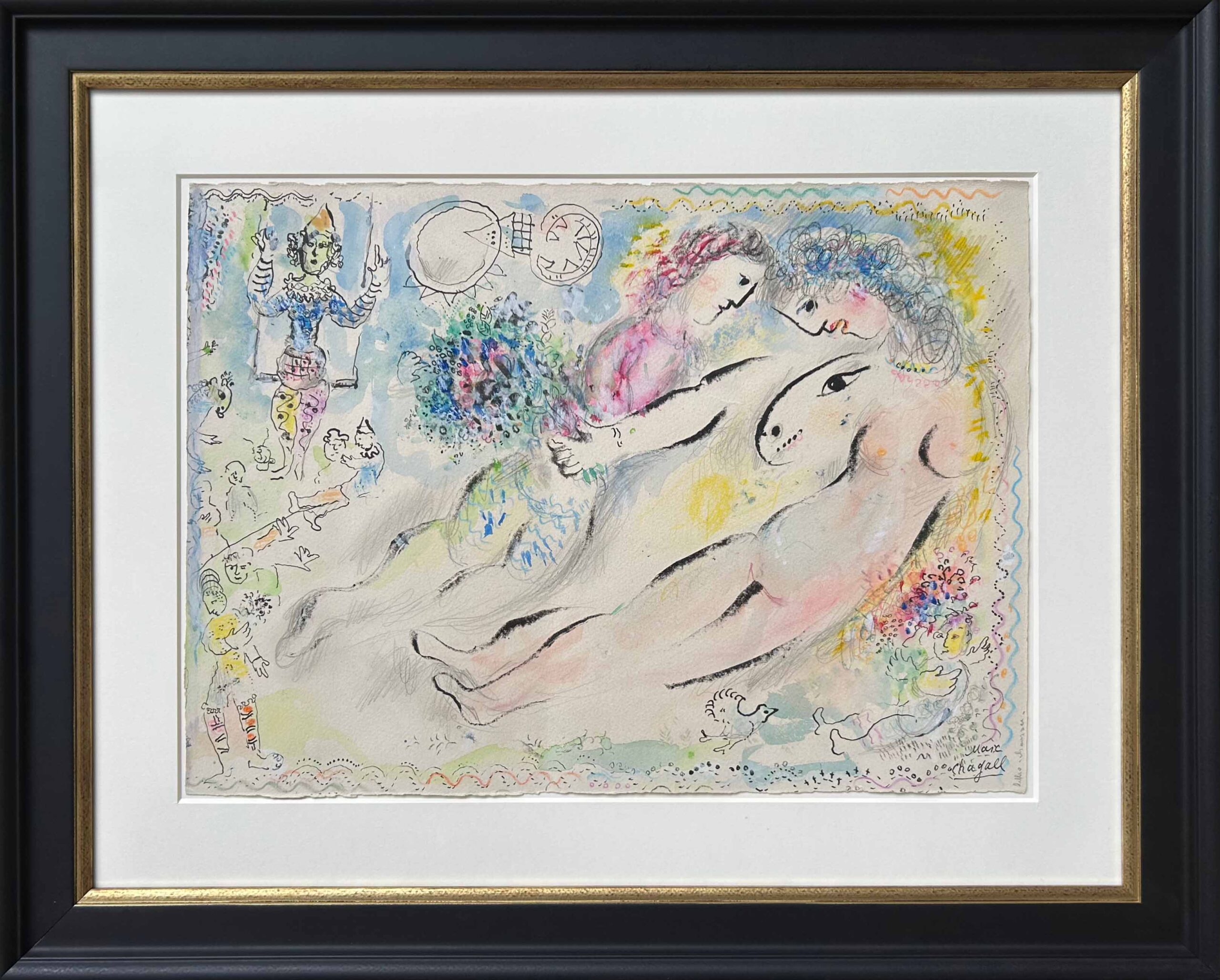
LIGHTS OF CIRCUS, 1969A unique variation on one of the major theme in Marc Chagall's work
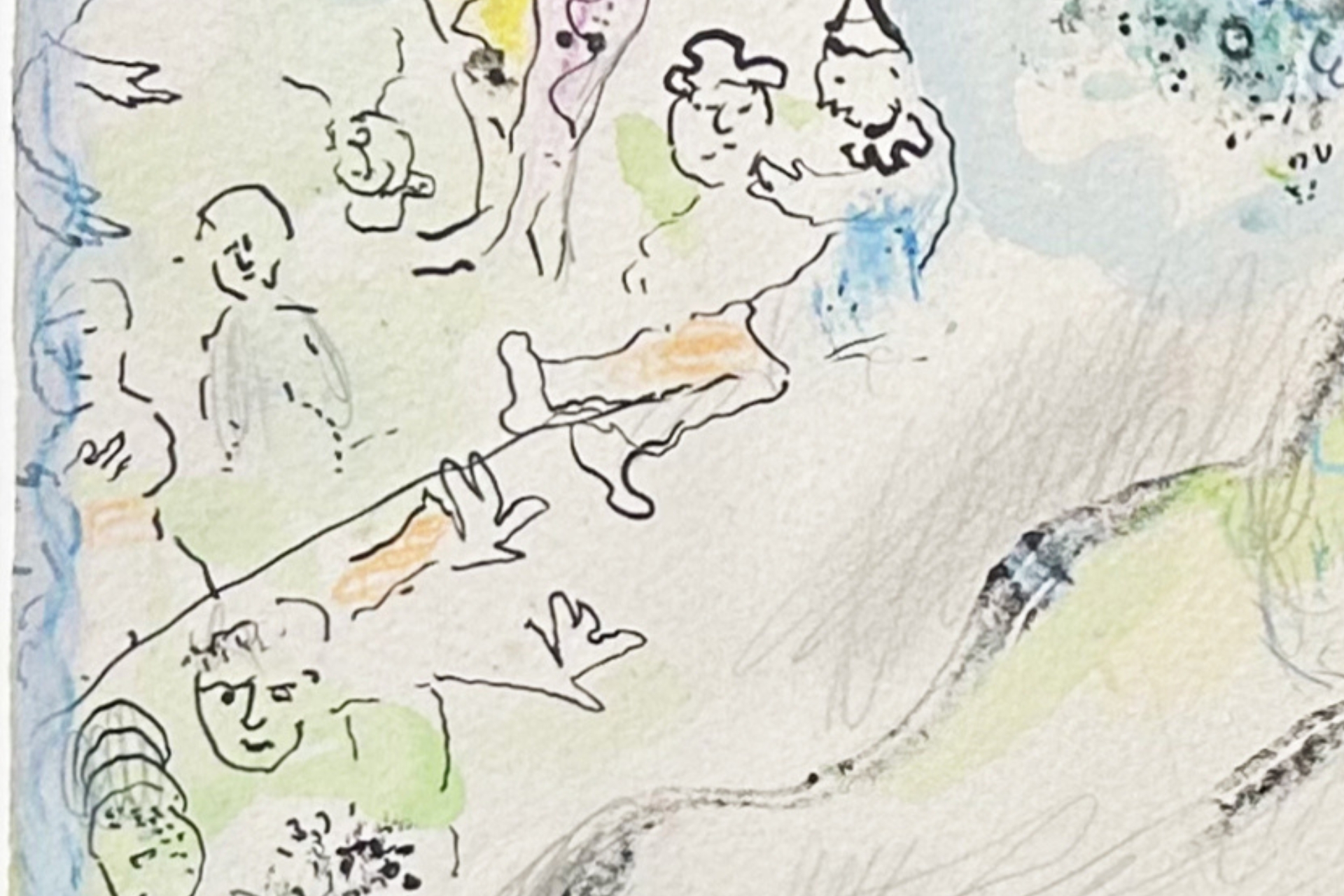
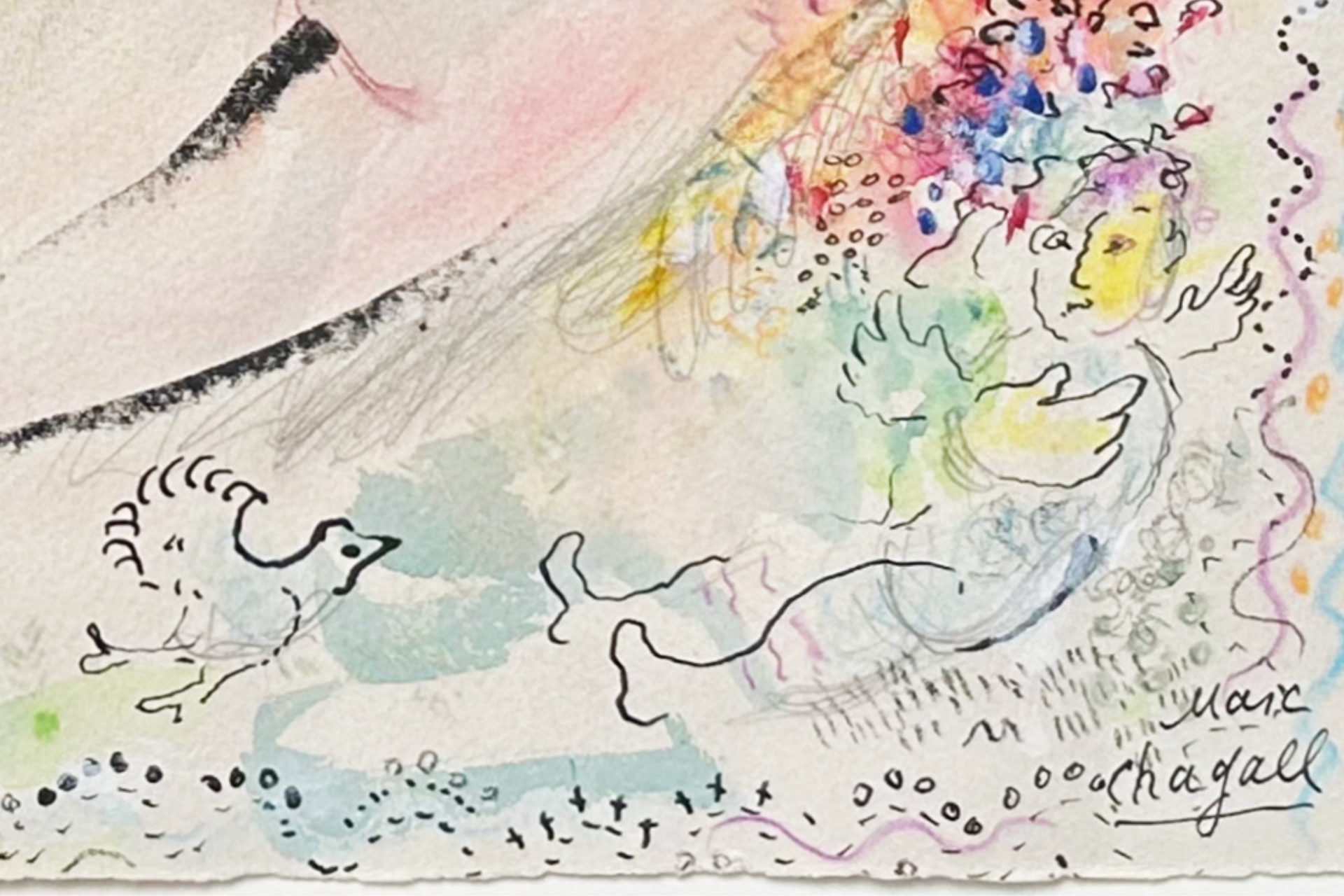
Created in 1969, Lumière du Cirque (Lights of Circus)ranks amongst the great works that Marc Chagall devoted to the world of the circus, a theme that ran through his work for over forty years. Executed in watercolour, pastel, gouache, coloured inks and pencil on a black print of lithograph M.566, this work demonstrates how the artist enriched certain prints through direct pictorial intervention, endowing them with the character of a unique creation.
Signed lower right, accompanied by a certificate from the Marc Chagall Committee and from a private French collection, this work brings together several of the fundamental themes of his artistic language: the circus, lovers, animals, music and colour. It also illustrates a conception of painting in which memories, symbols and emotions take precedence over a faithful representation of reality.
The circus: a central theme in the work of Marc Chagall
The world of the circus was a constant presence in Marc Chagall’s life throughout his career. His interest in this subject stemmed from his childhood in Vitebsk, where performances by travelling troupes were a regular feature of town life. These popular shows fuelled his imagination from a very early age and remained deeply etched in his memory.
This fascination deepened during the 1920s when the art dealer Ambroise Vollard commissioned him, amongst other works, to illustrate La Fontaine’s Fables. The two men then became regular visitors to the Cirque d’Hiver in Paris. Vollard encouraged these visits, convinced that this world would be a source of inspiration for the artist. It was during this period that the famous series known as the ‘Vollard Circus Gouaches’ was created, which had a lasting impact on the development of his work.
From the 1950s onwards, the circus became one of the most recurring themes in his work. Chagall did not, however, seek to depict a performance in a documentary sense. Acrobats, clowns, horse-riders, horses and musicians became the characters in an inner world where dreams take the place of reality. The artist himself drew a parallel between these characters and creators, with whom they share the ability to inspire wonder, move the viewer and spark the imagination.
This vision is summed up in one of his most famous statements:
‘My circus takes place in the sky; it takes place in the clouds amongst the chairs; it takes place in the window where the light is reflected.’
This quote sheds particular light on Lumière du Cirque (Lights of Circus), where the characters seem to move through a space free from all gravity.
An imagination shaped by his cultural heritage
To understand Marc Chagall’s world, it is also necessary to look back at his upbringing within the Hasidic Jewish community of Vitebsk. This mystical branch of Judaism places great emphasis on joy, music, dance and celebration as expressions of spirituality.
The festive scenes, musicians, couples in love, animals and bouquets of flowers that feature throughout his work find their origins, in part, in this culture where emotion and poetry take centre stage.
The circus thus appears as a natural extension of this world: a space where music, movement and celebration become the vehicles of a universal language.
The weightless figures, so characteristic of his artistic language, contribute to this quest for lightness and elevation. They convey a world freed from the laws of gravity, where celebration, love and dreams take precedence over everyday life. They can also be interpreted as an evocation of the plight of a people forced into exile, tossed from one territory to another at the whim of history – an experience that has profoundly shaped the artist’s life.
A composition in which each figure contributes to a poetic narrative
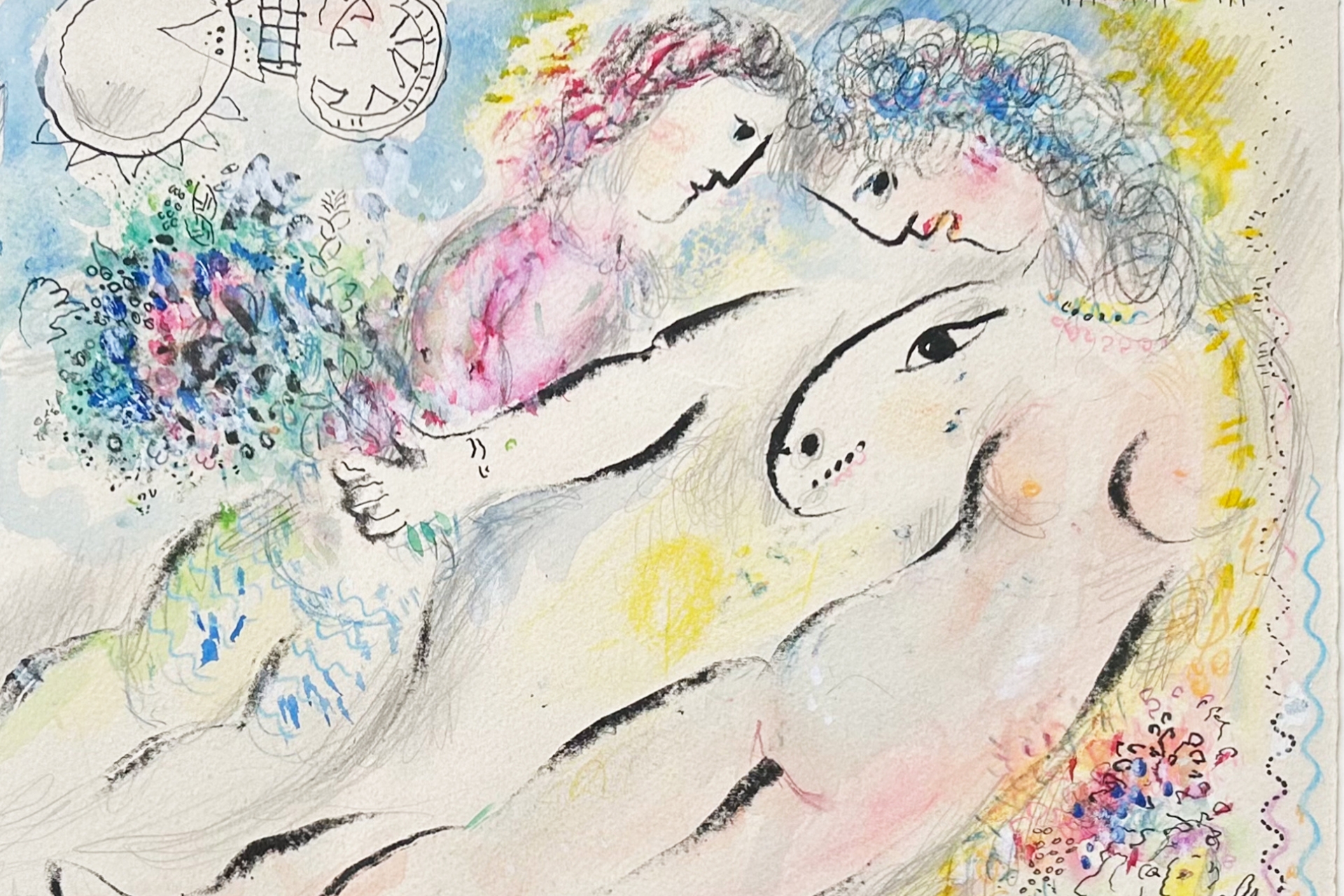
Lumière du Cirque (Lights of Circus) is centred on a large reclining female figure that occupies most of the composition. Drawn with a supple, continuous black line, she appears to float in a space devoid of any real perspective.
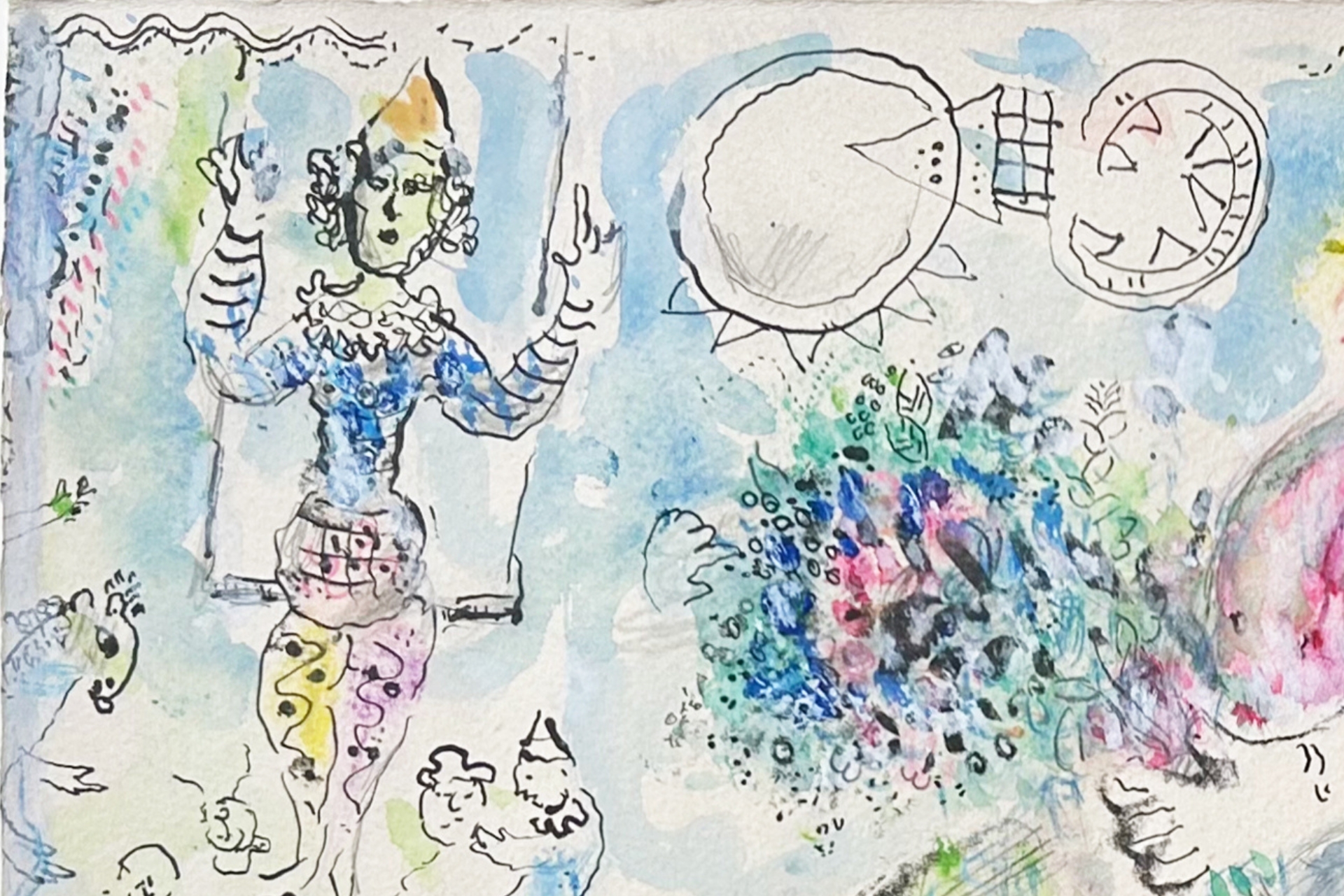
Her gaze meets that of a white horse, an emblematic figure in Chagall’s world. Above them appears a couple in love, their faces coming together in a moment of great tenderness. On the left-hand side, an acrobat suspended from her trapeze towers over a series of small silhouettes of spectators, whilst the sun and the moon coexist in the upper part of the composition.
As is often the case with Chagall, these elements do not constitute a single scene but rather an assemblage of memories, references and emotions. The varying scales, the absence of traditional perspective and the freedom of composition give the whole the appearance of a dream in which several time frames overlap.
Colour: a language in its own right
In Marc Chagall’s work, colour never seeks to faithfully reproduce reality. It constitutes a language in its own right, serving to support the forms even before describing them.
From his earliest years in Paris, the artist developed a deeply personal approach to colour, moving away from the naturalistic harmonies that were still largely dominant at the start of the 20th century. Blues, reds, greens and yellows become emotional spaces that organise the composition just as much as the line work.
Purple occupies a unique place in this exploration. Still relatively rarely used as a dominant colour by painters of his generation, it became a true tool of expression in Chagall’s work. Combined with blues, pinks and yellows, it helps to diffuse a light that seems to emanate from the colour itself rather than from an external source.
In Lumière du Cirque (Light of Circus), the watercolour, pastel and gouache strokes deliberately spill over the outlines; layers of transparency overlap, and the forms sometimes seem to dissolve into the light. Colour no longer describes the objects; it conveys their intensity.
Between a print and an original work
Lumière du Cirque is based on a black print of the lithograph catalogued as M.566, which Marc Chagall then reworked directly by hand.
This practice holds a special place in his body of work. The artist transforms the balance of the composition using watercolour, pastel, gouache, coloured inks and pencil. Each intervention alters the relationships between the figures, enriches the light and introduces a pictorial quality absent from the print.
A comparison with the colour lithograph reveals this freedom of interpretation. Whilst the overall structure remains the same, the colour harmonies, the distribution of pigments and the intensity of the contrasts differ significantly. The work presented here thus constitutes a unique variation on this composition.
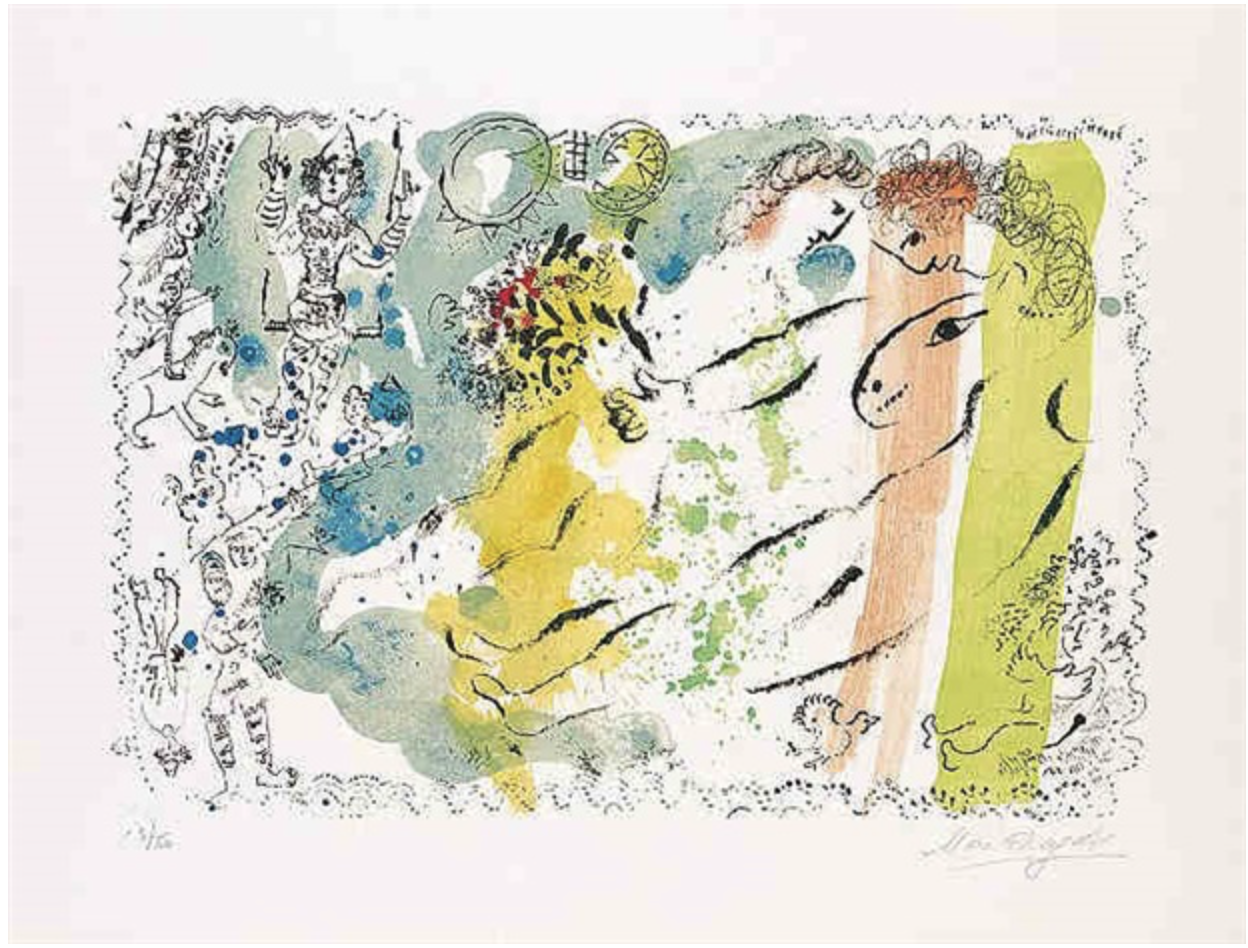
Marc Chagall, Lumière Du Cirque (Lights of Circus), 1969, lithography M.566 13/50
An overview of Marc Chagall’s artistic style
Created in 1969, Lumière du Cirque (Lights of Circus) dates from a period when Marc Chagall was enjoying international recognition whilst continuing to exercise remarkable creative freedom. Based in Saint-Paul-de-Vence, he was at that time dividing his time between painting, printmaking, stained glass, mosaics, ceramics and monumental sculpture.
This work brings together the key elements that underpin his artistic identity: a space liberated from the laws of perspective, an iconography drawn from personal memories, an immediately recognisable symbolic language, and colour used as a vehicle for emotion.
More than a depiction of the circus,Lumière du Cirque (Lights of Circus) offers a synthesis of Marc Chagall’s worldview. The circus performers, lovers, animals and musicians are figures from an inner world where memory, poetry and creativity merge in a single light.
Céline Fernandez
With 15 years’ experience in marketing and communications, Céline has worked for major companies such as the Hopscotch agency, the Galerie Lafayette Group and several communications agencies. Since 2019, she has been managing the gallery’s communications via its website, social media and traditional media.
__
This article draws on the principal works devoted to Marc Chagall and his art:
Franz Meyer, Marc Chagall, Harry N. Abrams, New York, revised edition, 1963 (several reprints). This is the first major scholarly monograph devoted to the artist, written by his son-in-law, an art historian.
Charles Sorlier, Chagall Lithographe, 6 volumes, André Sauret Éditeur, Monte Carlo, 1960–1986. The catalogue raisonné of Marc Chagall’s lithographs, in which lithograph M.566 is listed.
Jean-Louis Prat, Chagall ou la lumière de l’origine, Éditions Gallimard / Fondation Maeght, 1995. A seminal study devoted to the artist’s poetic and spiritual world.
Meret Meyer, Marc Chagall. Life and Work, Hatje Cantz, 2018. A recent overview of the artist’s life and work, based on the family archives.
Marc Chagall Committee, scholarly documentation and certificate of authenticity for the work Lumière du Cirque, 1969.
Marc Chagall National Museum (Nice), scholarly documentation focusing on the major themes in Marc Chagall’s work, notably the circus, colour and symbols.
Marc Chagall Foundation (marcchagall.com), section dedicated to the theme of the circus and the artist’s writings.
The theme of the circus first appeared in Chagall’s work in the 1920s and became one of his major subjects from the 1950s onwards.¹
Puis en bas :
¹ Charles Sorlier, Chagall Lithographe, vol. V, André Sauret, Monte-Carlo.
Ou encore :
Chagall déclarait : « Mon cirque se joue dans le ciel… »²
² Fondation Marc Chagall, Le Cirque, citation reproduite dans les archives de la Fondation.