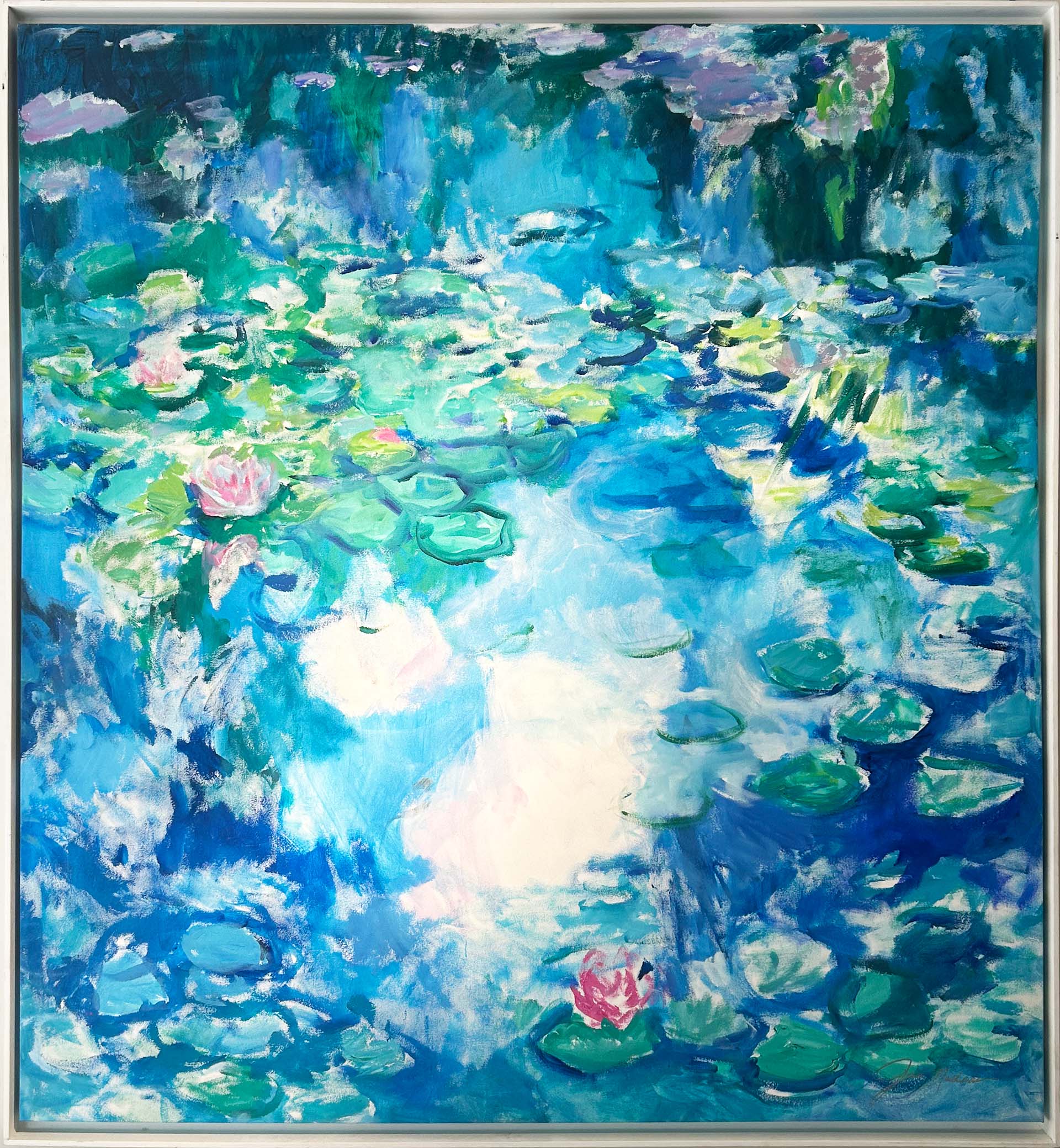



WATER LILY, 2019A Work by Josée Nadeau in the Tradition of Claude Monet
On December 5, 2026, it will be one hundred years since the irreplaceable Claude Monet left his studio in Giverny, leaving behind the impression of light that still shines brightly. Nearly a century later, it is possible to sense the contemporary spirit of this extraordinary legacy through the work of Josée Nadeau.
Josée Nadeau, a Canadian artist who divides her time between North America and Europe
This Canadian artist, born in Montreal in 1963, took her first drawing classes in 1970, at the age of 7. Her teachers immediately noticed her unusual perception of light for someone her age. In 1976, she obtained written permission from her parents to enroll in adult life-drawing classes at the Ottawa School of Art. In 1985, she earned her Bachelor of Fine Arts (BFA) degree from Concordia University in Montreal, a major hub for Canadian contemporary and abstract art. Fresh out of college, she joined Emma Lake’s legendary studio, an iconic site of the modernist avant-garde and landscape abstraction in Canada. It was under the boundless skies of Saskatchewan, surrounded by figures such as Dorothy Knowles, William Perehudoff, and David Alexander, that she honed her ability to structure space in all its grandeur. Josée Nadeau then experienced a pivotal artistic awakening, which also shaped the way she approaches the monumentality of her canvases.
From Madrid to the vast North American landscapes
In 1986, she left for Europe and settled for a time in Spain, where she studied and refined her technique at the renowned Royal Academy of Fine Arts of San Fernando in Madrid until 1990. Historically, this is the school where Salvador Dalí and Pablo Picasso had trained before her. Upon her return to Canada in 1993, she settled temporarily in the wilderness of Whistler, British Columbia, to capture the dense forests and Pacific coastal light in her paintings. In 1995, she moved to the mountains of Park City, Utah. This high-mountain setting became a new visual playground, steering her painting toward a drier, more contrasting color palette.
Josée Nadeau in Giverny: Ten Years in the World of Claude Monet
Her encounter with the Van der Kemp couple in 1998 had a profound impact on the artist’s creative world. Gérald Van der Kemp, the legendary curator who helped save the Mona Lisa during World War II, restored the Palace of Versailles, and brought Claude Monet’s house and gardens in Giverny back to life, was captivated by Josée Nadeau’s work. For ten years, she spent every flowering season in Giverny. She stayed in the curators’ VIP suite and enjoyed privileged access to the grounds and Claude Monet’s famous water lily ponds. In 2001, Florence Van der Kemp seated Josée Nadeau at the head table of the Bal de Versailles. By that time, Hollywood celebrities such as Pierce Brosnan and David Hyde Pierce had begun collecting her paintings.
From Painting to Live Painting: When Music Guides the Brushstroke
During a visit in 2000 to her fellow Quebecer Guy Laliberté, founder of Cirque du Soleil, she had a life-changing encounter with George Harrison. The musician played guitar and sang for her for several hours. This experience helped spark in Josée Nadeau the idea of combining musical performance with the act of painting. This approach would gradually give rise to her “Live Painting” performances, during which music, rhythm, and the act of painting interact directly. In 2012, the artist participated in a concert in Miami celebrating Dionne Warwick’s 50-year career, where she created a massive portrait on stage, in front of an audience of 1,000 people, in sync with the song “Do You Know the Way to San Jose.” In April 2010, she received the international “Success Story” award at Artexpo New York for her entire career and the originality of her stage performances. During the 2014 “Footsteps of Mandela” show at Riverside Church in New York, she created a monumental and vibrant portrait live on stage in memory of Nelson Mandela. Since 2015, she has been participating in numerous international art fairs, such as Artexpo New York, the Modern Art Fair in Paris, and various fairs in Miami and Palm Beach. She has also begun exhibiting “as a duo” with her son Nicholas Grant, whose first artistic steps she guided. His historic recognition in Giverny is reflected in the European art market: his masterful painting titled *The Great Water Lilies of Giverny* was sold in 2022 at Gros & Delettrez in Paris for 29,000 euros.
From Painting to Live Painting: When Music Guides the Brushstroke
Josée Nadeau’s work revolves around a unique fusion of the legacy of French Impressionism and North American Abstract Expressionism.
The large scale of her works allows her to express a liberated, almost choreographic style. Unlike the classical Impressionists, Josée Nadeau, using large brushes and sometimes palette knives, applies paint in a bold, textured manner. Her canvases are not merely figurative representations of subjects, but a testament to the liberation of the body and color. One can sense in her brushwork a sense of urgency, driven by the desire to capture the immediacy of emotion. The heart of her work lies in recreating the atmospheric essence of the scenes and landscapes she encounters. Claude Monet and Josée Nadeau, both deeply influenced by the legendary landscapes of Giverny, present us—in very different ways—with contours that fade in favor of light.