



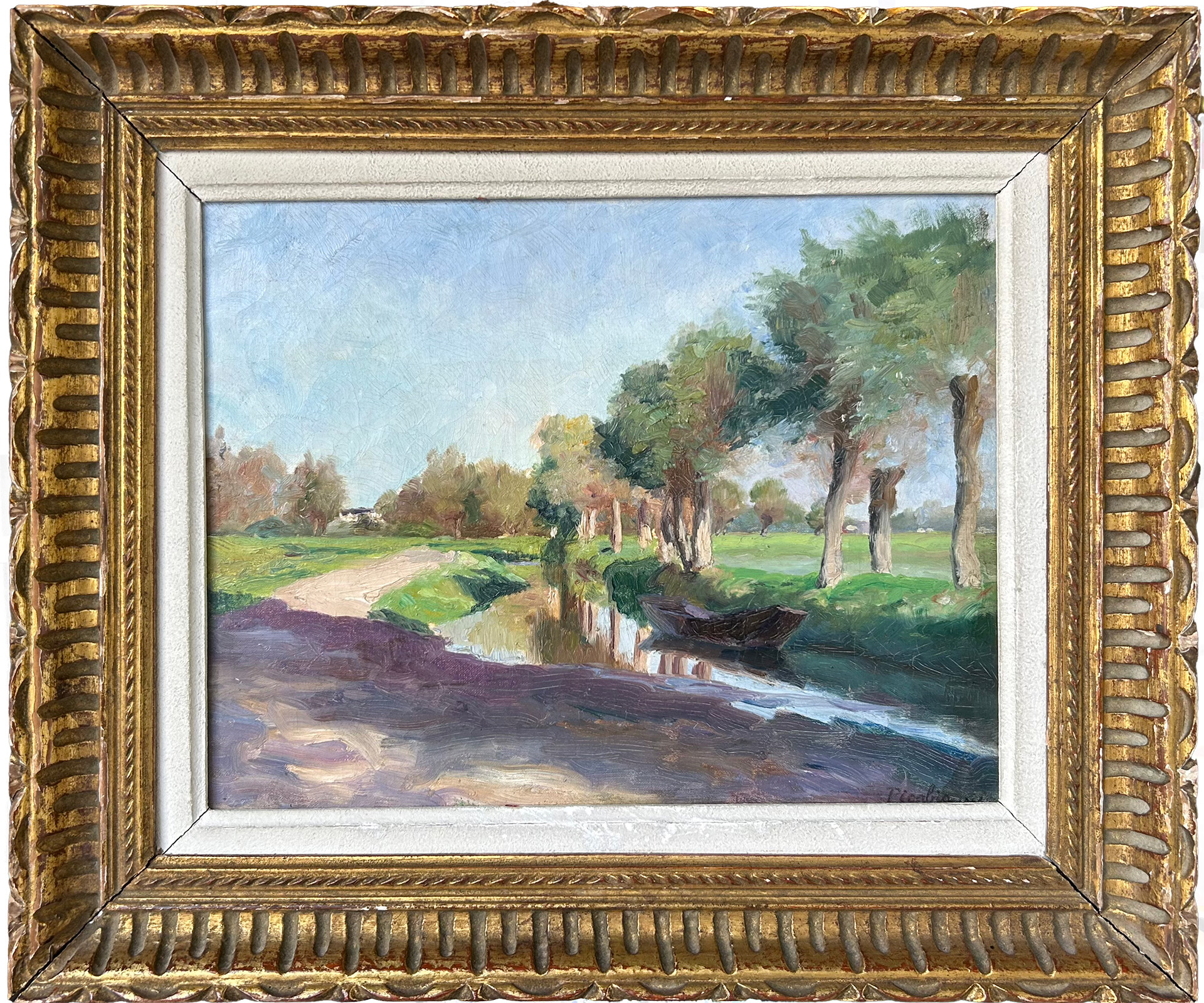
UNTITLED, 1901Francis Picabia : un paysage avant les grandes ruptures.
Long before Dada, mechanomorphic compositions, and abstract experiments, Francis Picabia painted landscapes. Created in 1901, this oil on canvas on display at the Hurtebize Gallery offers a glimpse of the artist at the very beginning of a career that would be marked by an exceptional series of stylistic transformations.
Picabia before Picabia
In 1901, Francis Picabia (1879–1953) turned 22. Having studied at the École des Arts Décoratifs in Paris beginning in 1895, he had already made his debut at the Salon des Artistes Français in 1899 with Une rue aux Martigues. Two years later, he exhibited there again and also participated in the 10th Exhibition of the Paris-Province Artistic and Literary Society, held at the Galerie Georges Petit.
It is within this context that this work, Untitled, dated 1901, finds its place. A small-format landscape in which a path runs alongside a tree-lined stream, while a rowboat appears in the foreground. The composition invites the viewer’s gaze to move through the landscape, between the masses of vegetation and their reflections.
Close-ups particularly reveal the artist’s handling of the medium: visible, fluid brushstrokes build up the foliage, water, and sky, while greens, blues, ochres, and purplish tones structure the various planes.
A work from the dawn of Picabia's Impressionist period
However, the significance of these early years in Picabia’s oeuvre deserves to be qualified. The first volume of the catalogue raisonné, covering the years 1898–1914, discusses his early Impressionist works dating back to the late 1890s. The biography published by the Picabia Committee, meanwhile, specifies that it was after 1902 that the influence of Camille Pissarro and, above all, Alfred Sisley became apparent in his painting, marking the emergence of his Impressionist period.
This period reached its full development by the middle of the decade. In 1905, his first solo exhibition was organized by Danthon; Picabia then refined his Impressionist technique during a particularly prolific period.
The significance of this 1901 painting lies precisely in its early date: it offers a glimpse into the work of a young artist before the successive artistic styles with which his name would become associated had fully taken shape.
Francis Picabia: A Body of Work in Constant Evolution
Attempting to categorize Francis Picabia within a single movement would be almost contradictory to his artistic journey.
After his Impressionist period, between 1909 and 1914 he explored Fauvism, Futurism, Cubism, and Orphism, before creating major Cubist and abstract works around 1912–1914.
Starting in 1915 came his mechanomorphic compositions and his central role in Dada. In the 1920s and 1930s, new figurative forms emerged: the “Monsters” and then the famous “Transparencies.” Toward the end of his life, Picabia returned once again to a deeply personal form of abstraction. The catalogue raisonné, moreover, underscores just how much his work defies any conventional stylistic continuity.
For Picabia, transformation thus becomes a form of permanence.
Looking at this 1901 painting is therefore like tracing the origins of this artistic journey: a Picabia before all the metamorphoses that would make him Picabia.
Untitled, 1901 — Francis Picabia

Céline Fernandez
With 15 years of experience in marketing and communications, Céline has worked for major companies such as the Hopscotch agency, the Galerie Lafayette Group, and several communications agencies. Since 2019, she has managed the gallery’s communications through its website, social media, and traditional media.