


Biography
An independent youth on the fringes of surrealism
Leonor Fini was born in Buenos Aires in 1907 to an Italian father and a mother of Slavic origin. She grew up in Trieste. Attracted to painting from an early age, she was largely self-taught, observing the old masters in museums and immersing herself in literature, psychoanalysis, and mythology. This free education partly explains the originality of her style, which defies academic rules while demonstrating great technical mastery. From the outset, she showed a pronounced taste for figurative art, meticulous detail, and the rigorous construction of bodies and faces.
Early days in Trieste, Milan, and Paris: a unique pictorial style
In the 1930s, Leonor Fini moved to Milan and then Paris, where she became part of the avant-garde circles. Her first solo exhibition in Milan in 1931 already revealed an assertive style: monumental figures, often frontal, with sharp contours and smooth, almost sculptural skin. In Paris, she frequented the Surrealists, sharing their interest in dreams and the unconscious, but her visual language was distinguished by its great formal clarity. Unlike the automatism dear to André Breton, Fini favored a highly constructed style of painting, inherited from the Italian Renaissance and Mannerism, in which each element was carefully composed.
A painter of myth, femininity, and androgyny
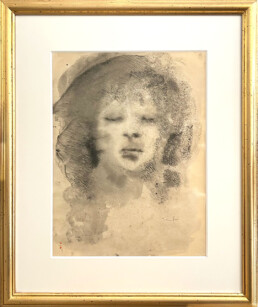
Leonor Fini‘s style is characterized by a mythological and theatrical universe populated by sphinxes, chimeras, sovereign women, and androgynous figures. She often uses a muted and refined palette of ochres, deep greens, browns, and bluish grays, which contributes to the timeless atmosphere of her paintings. The elegant, elongated bodies are treated with a cold sensuality and great precision of drawing. Through these figures, she challenges traditional representations of femininity: in her work, women are neither muses nor objects, but figures of power, mystery, and domination.
War, exile, and a deepening of dreamlike imagery
During World War II, Léonor Fini left Paris and took refuge in the south of France, then in Italy. This period reinforced the dreamlike and introspective dimension of her work. Her compositions became more enigmatic, sometimes darker, while retaining a high degree of formal clarity. The settings became increasingly important: deserted landscapes, imaginary architecture, and enclosed spaces that accentuated the theatrical nature of the scenes. Fini’s painting thus appeared as a mental space where dreams, myths, and introspection intersected.
A transdisciplinary body of work with a recognizable style
After the war, Leonor Fini pursued an international career and developed her style with remarkable consistency. She collaborated extensively with theater and opera companies, designing sets and costumes, which directly influenced her painting: dramatic poses, a taste for masks, sumptuous costumes, and the staging of the body. Her precise, almost classical lines contrast with the subversive nature of her themes. This tension between formal mastery and transgressive imagination is one of the major hallmarks of her style.
The stylistic legacy of a rebellious artist
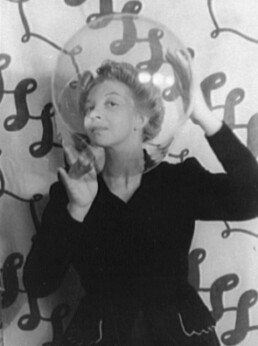
Leonor Fini died in Paris in 1996, leaving behind a prolific and instantly recognizable body of work. Her style, both erudite and provocative, combines references to ancient art, symbolism, and surrealism without ever submitting to them. By asserting a powerful, theatrical, and deeply mythical figuration, she opened up a unique path in 20th-century art. Today, her work is recognized for the strength of its visual language and for the way it questions identity, gender, and power through painting.